 Login

Program Overview
The Medicare GLP-1 Bridge program may help eligible Medicare Part D beneficiaries access certain GLP-1 medications for obesity care at a $50 monthly copay.
OAC created these resources to help patients, caregivers and the community understand what the program means, who may qualify and what questions to ask. While the Bridge program is temporary, it is an important step toward improving access and supporting more informed conversations about obesity care.
Additional Frequently Asked Questions are answered below.
 Play this video to learn more.
Resources
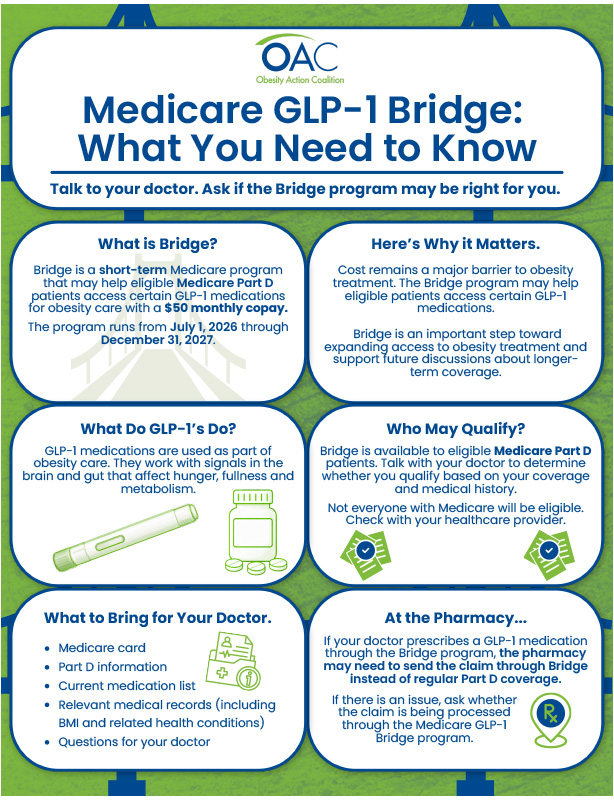
What You Need to Know (.PDF)
Download

How to Talk to Your Doctor (.PDF)
Download

How to Talk to Your Pharmacist (.PDF)
Download
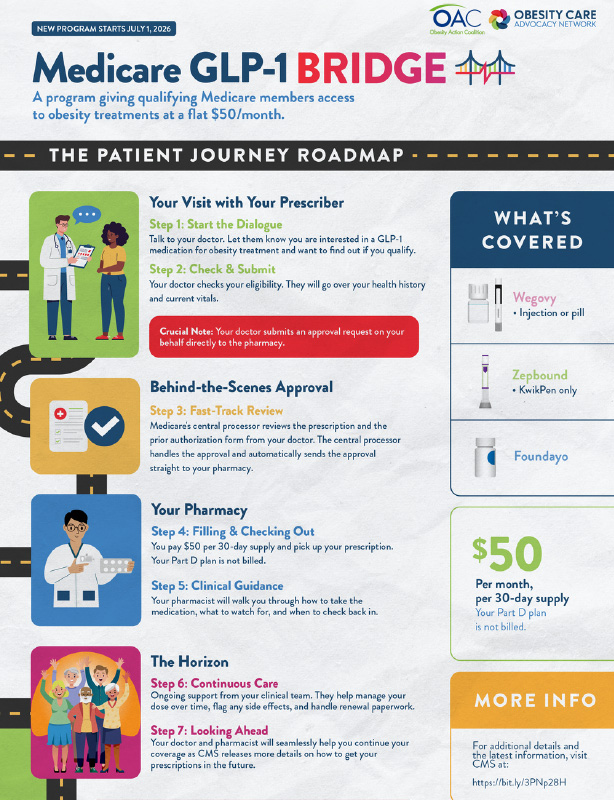
The Patient Journey Roadmap (.PDF)
Download
Free Resources for Healthcare Providers
Free Medicare GLP-1 Bridge Resources for Healthcare Providers
Help your patients start informed conversations about obesity care. OAC offers free, printable resources for healthcare providers to share with Medicare patients who may be eligible for the Medicare GLP-1 Bridge program.
Download the exam room and waiting room flyers to display in your practice and help patients learn key program details, including eligibility, possible $50 monthly copays and questions to ask during their visit.
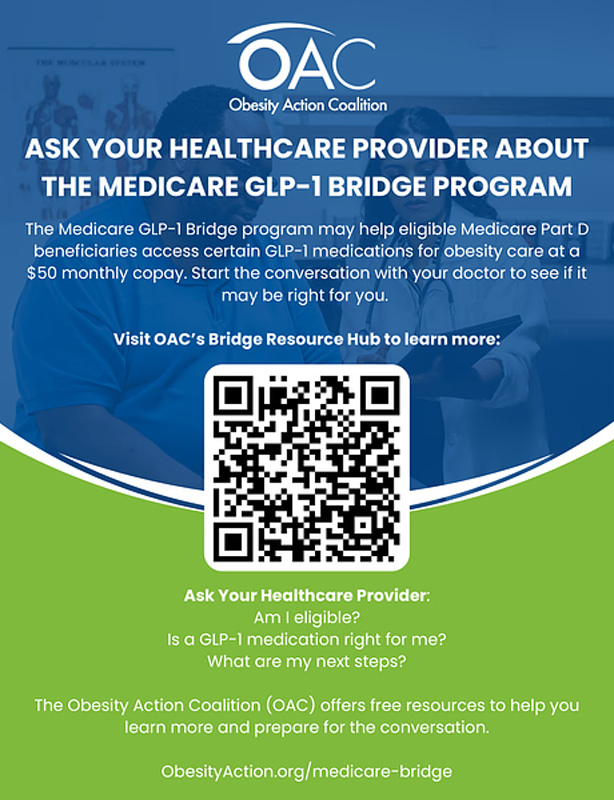
Waiting Room Flyer (.PDF)
Download
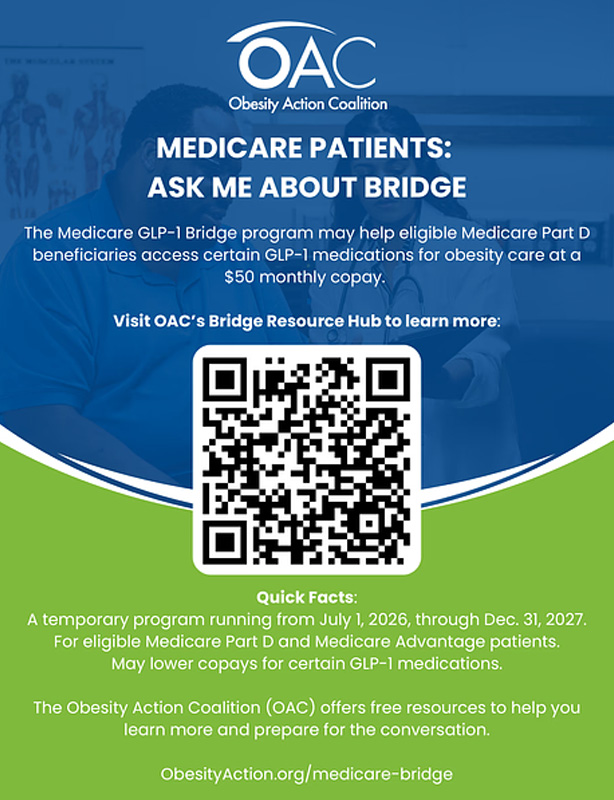
Exam Room Flyer (.PDF)
Download
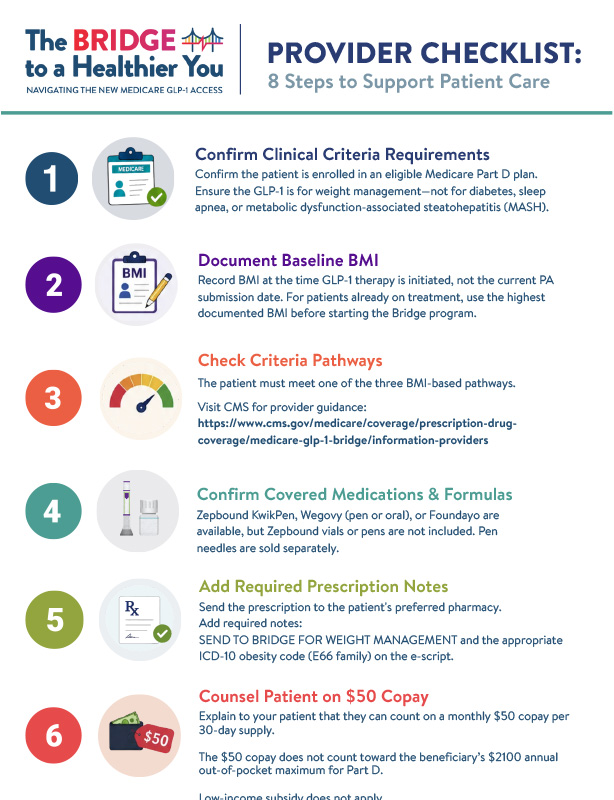
Provider Checklist (.PDF)
Download
Frequently Asked Questions
The OAC is committed to helping you understand your treatment options and navigate the new Medicare Bridge Program. The FAQs below explain what Bridge is, who may qualify and what to expect. Because the program may continue to evolve, we encourage you to visit the Medicare Bridge website for the latest updates and official program information.
Jump to:
General
- What is Bridge?
-
-
- Bridge is a new Medicare program that helps some people with Medicare Part D or a Medicare Advantage plan get access to certain GLP-1 medicines used to treat obesity. The program is designed to make these medications more affordable for people who qualify.
-
- Who can participate in Bridge?
-
-
- Anyone with a Medicare Part D or a Medicare Advantage plan and meet the program’s eligibility requirements. You must also have a prescription from your healthcare provider for a covered GLP-1 medication.
-
- What are the eligibility requirements?
-
-
- To be eligible for the Bridge program, you must:
- Have Medicare Part D or a Medicare Advantage plan.
- Meet the medical requirements for one of the covered GLP-1 medications.
- Have a healthcare provider prescribe the medication.
- To be eligible for the Bridge program, you must:
-
- How much will GLP1s cost?
-
-
- If you qualify for Bridge, you will pay a $50 copay for each one-month supply of a covered medication.
-
- Which medications are covered?
-
-
- Wegovy® – injection
- Wegovy® Pill – oral tablet
- Zepbound® – injection (KwikPen® only*. The program doesn’t cover single-dose Zepbound® vials or pens. *injections supplies are not included)
- Foundayo® – oral tablet
-
- Is coverage with Bridge permanent?
-
- No. Bridge is a temporary program that runs from July 1, 2026, through December 31, 2027. Medicare will use the information it learns from the program to help guide future coverage decisions.
- How do I contact Medicare with questions about Bridge?
-
- The Medicare GLP-1 Bridge Call Center is available at 855-273-0102 Monday through Friday from 8am – 7pm ET.
Patients
-
- Do I qualify for Bridge? Use the OAC Medicare Bridge Navigator to check your eligibility.
- To qualify for Bridge, you must:
- Be 18 years of age or older.
- Have Medicare Part D or a Medicare Advantage prescription drug plan.
- Have a prescription for a covered GLP-1 medication from your healthcare provider.
- Meet one of these health requirements:
- Your Body Mass Index (BMI) is 35 or higher, or
- Your BMI is 30 or higher and you have at least one of these conditions:
- Heart failure with preserved ejection fraction (HFpEF)
- High blood pressure that is not controlled with medication
- Chronic kidney disease (Stage 3a or higher)
- Your BMI is 27 or higher and you have at least one of these conditions:
- Prediabetes
- A previous heart attack
- A previous stroke
- Peripheral artery disease (PAD) with symptoms
- If you’re not sure what your BMI is or whether you have one of these conditions, talk with your healthcare provider. They can help you determine if you qualify for Bridge.
- To qualify for Bridge, you must:
- Do I qualify for Bridge? Use the OAC Medicare Bridge Navigator to check your eligibility.
- Can my current healthcare provider prescribe my medications for Bridge?
-
-
- Yes. Any licensed healthcare provider who can prescribe medications can write a prescription for a covered GLP-1 medication through Bridge. You do not need to see a specialist or switch to a different healthcare provider to participate in the program.
-
- Do I have to use a specific pharmacy to get GLP1 medications through Bridge?
-
-
- No. You can use any pharmacy that accepts Medicare Part D or Medicare Advantage prescription drug coverage.
- Check with your pharmacy to make sure they can fill your prescription through the Bridge program.
-
- What if I’m currenting taking a GLP-1 or undergoing other obesity treatments and my BMI is below the requirement?
-
-
- You may still qualify. Bridge uses the BMI you had when you first started your GLP-1 medication or obesity treatment—not your current BMI. If your BMI has gone down because your treatment is working, you may still be eligible if you met the BMI requirement when treatment began. Your healthcare provider will have to provide documentation of your starting BMI if needed.
-
- I’ve been using a compounded GLP-1, will I be allowed to switch to the medications available through Bridge?
-
-
- Yes. If you meet the Bridge eligibility requirements, your healthcare provider can prescribe a covered FDA-approved GLP-1 medication through the program. The Bridge program covers Wegovy®, Zepbound® KwikPen® and Foundayo®. Talk with your healthcare provider about whether switching from a compounded GLP-1 medication is right for you.
-
- I’m taking a non-GLP-1 FDA approved obesity medication, is it available for $50?
-
-
- No, currently only GLP-1s are covered in the Bridge program are the following:
- Wegovy® – injection
- Wegovy® Pill – oral tablet
- Zepbound® – injection (KwikPen® only*. The program doesn’t cover single-dose Zepbound® vials or pens. *injections supplies are not included)
- Foundayo® – oral tablet
- No, currently only GLP-1s are covered in the Bridge program are the following:
-
- What if my healthcare provider won’t prescribe a GLP-1 for me?
-
-
- If your provider is not open to discussing GLP-1 treatment or explaining your options, the OAC Provider Locator can help you find a healthcare provider in your area who understands obesity care.
-
- I have both Medicare and Medicaid (Dual Eligible), can I participate in Bridge?
-
-
- Yes, people who have both Medicare and Medicaid may be eligible for the Bridge Program.
- However, if your state Medicaid program covers GLP-1 medications for weight management, you may want to explore that coverage first because your out-of-pocket costs could be lower than they would be through Bridge. If you are already receiving a GLP-1 for weight management through Medicaid, staying with your current coverage may be the more affordable option.
- Medicaid coverage and eligibility requirements vary by state. This means you could qualify for Bridge even if you do not qualify for GLP-1 coverage through your state’s Medicaid program.
- Before using Bridge, check with your state Medicaid program to understand your coverage options and determine which option may be best for you.
- Yes, people who have both Medicare and Medicaid may be eligible for the Bridge Program.
-
- How long does it take to be approved through the Bridge?
-
-
- The Bridge process may take a few days to a week, depending on how quickly each step is completed.
- First, your healthcare provider sends your prescription to the pharmacy. When the pharmacy submits the prescription to Bridge, the initial claim will be denied. This denial is an expected part of the process and triggers a request for your healthcare provider to complete a prior authorization (PA).
- Your provider will then submit information showing that you meet the Bridge eligibility requirements. Once the prior authorization is reviewed and approved, your pharmacy can process your prescription through Bridge.
- The exact timing may vary. You can help keep the process moving by checking with your healthcare provider to make sure they received the prior authorization request and submitted the required information.
- The Bridge process may take a few days to a week, depending on how quickly each step is completed.
-
- My doctor received a denial from Bridge? How can I appeal?
-
-
- It depends on where you are in the process.
- If this is the first denial: Don’t worry. The initial denial is an expected part of the Bridge process. When your pharmacist first submits your prescription to Bridge, the claim is automatically denied. This triggers a request to your healthcare provider to submit the required prior authorization (PA). This initial denial does not mean that you are not eligible for Bridge.
- If your prior authorization was submitted and you were then told you are not eligible: Bridge does not have a formal appeals process. However, your healthcare provider can submit a new request if they have updated or additional information that may show you meet the eligibility requirements.
- It depends on where you are in the process.
-
- I received a notice that the prescribed GLP-1 is out of stock, is there a shortage?
-
- Not necessarily. Many pharmacies do not routinely keep every GLP-1 medication and dose in stock. Because these medications require refrigeration and are available in multiple brands and doses, pharmacies may need to order your specific prescription.
- In many cases, the medication may arrive within a day or shortly after it is ordered. Ask your pharmacist when they expect your prescription to be available.
- An “out of stock” message from your pharmacy does not necessarily mean there is a nationwide shortage of your medication.
- Is there information I can give to my healthcare provider so they can help me get GLP-1s through Bridge?
-
-
- Yes. The OAC created a one-pager you can give to your provider.
-
- Is there information I can take to the pharmacy so they understand how to process my prescription for GLP-1s through Bridge?
-
-
- Yes. The OAC created a one-pager you can take to your pharmacists.
-
- How do I contact Medicare with questions about Bridge?
-
- The Medicare GLP-1 Bridge Call Center is available at 855-273-0102 Monday through Friday from 8am – 7pm ET.
- Is there information I can give to my healthcare provider so they can help me get GLP-1s through Bridge?
-
-
- Yes. The OAC created a one-pager you can give to your provider.
-
- Is there information I can take to the pharmacy so they understand how to process my prescription for GLP-1s through Bridge?
-
- Yes. The OAC created a one-pager you can take to your pharmacists.
What if I’m not eligible for Bridge?
- I don’t have a Part D or Medicare Advantage plan, when can I enroll in one?
-
- Typically, Medicare Part D enrollment is limited to certain times of the year referred to as Open Enrollment. However, there are other times when a person can enroll based on certain situations. Visit Medicare Joining a Plan website for general information and click on “Other times when you can join a health or drug plan.” for details on specifics regarding special enrollments. Penalties may apply for late enrollment, be sure to understand all costs before enrolling.
- I have coverage for another FDA-approved GLP-1 indication (such as type 2 diabetes, obstructive sleep apnea (OSA) or metabolic dysfunction-associated steatohepatitis (MASH)), but the cost is still too high. Are there any ways to make the out of pocket costs more affordable?
-
- Medicare Prescription Cap – Out-of-pocket spending on covered Part D drugs is capped at $2,100 in 2026. After you reach the cap, you won’t have to pay out-of-pocket for covered Part D drugs for the rest of the calendar year.
- Medicare Prescription Payment Plan – The Medicare Prescription Payment Plan is a payment option that works with your current drug coverage to help you manage your out-of-pocket costs for drugs covered by your plan by spreading them across the calendar year (January–December). https://www.medicare.gov/prescription-payment-plan
- Extra Help – “Extra Help” is a Medicare program to help people with limited income and resources pay Medicare drug coverage (Part D) premiums, deductibles, coinsurance and other costs.
- I have another FDA-approved indication for GLP-1 medications, such as type 2 diabetes, obstructive sleep apnea (OSA) or metabolic dysfunction-associated steatohepatitis (MASH), but my Part D or Medicare Advantage plan denied coverage. What can I do to get a GLP-1?
-
- If your Medicare Part D or Medicare Advantage plan denies coverage for your medication, your plan is still responsible for reviewing your request.
- You have the right to ask your plan for a coverage determination, request a formulary exception if needed and appeal the decision if coverage is denied.
- For resources on understanding your prescription benefits and how to file an appeal check out the following videos:
- If your Medicare Part D or Medicare Advantage plan denies coverage for your medication, your plan is still responsible for reviewing your request.
- I have prescription coverage through TRICARE for Life, can I participate in Bridge?
-
- No. To participate in Bridge, you must be enrolled in Medicare Part D or a Medicare Advantage plan that participates in the program. TRICARE for Life prescription coverage does not qualify for Bridge.
If you have additional questions about the Medicare Bridge program email advocacy@obesityaction.org and include Bridge in the subject line.
Providers
The Centers for Medicare and Medicaid Services (CMS) has FAQ for providers.
Pharmacists
The Centers for Medicare and Medicaid Services (CMS) has a FAQ for pharmacists.
