 Login



Your Benefits, Your Voice: Advocating for Better Obesity Coverage at Work

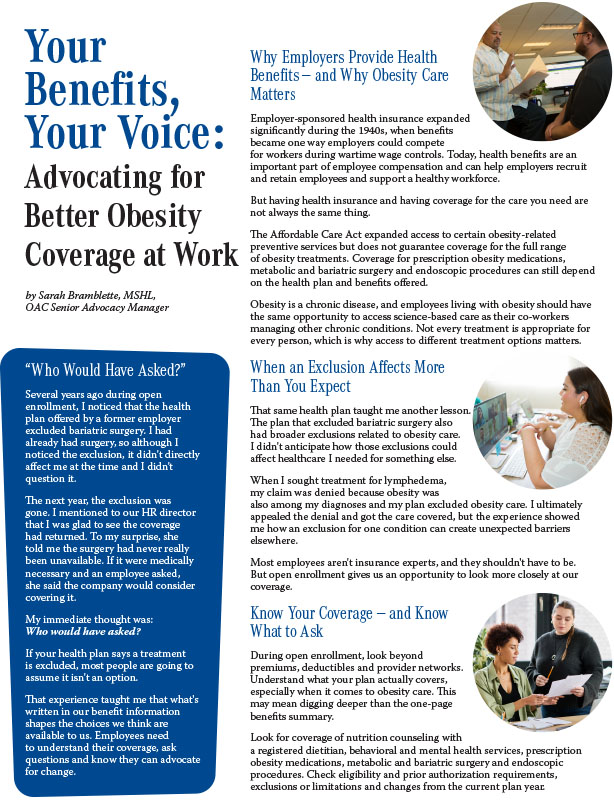
by Sarah Bramblette, MSHL, OAC Senior Advocacy Manager
Fall 2026
“Who Would Have Asked?”
Several years ago during open enrollment, I noticed that the health plan offered by a former employer excluded bariatric surgery. I had already had surgery, so although I noticed the exclusion, it didn’t directly affect me at the time and I didn’t question it.
The next year, the exclusion was gone. I mentioned to our HR director that I was glad to see the coverage had returned. To my surprise, she told me the surgery had never really been unavailable. If it were medically necessary and an employee asked, she said the company would consider covering it.
My immediate thought was: Who would have asked?
If your health plan says a treatment is excluded, most people are going to assume it isn’t an option.
That experience taught me that what’s written in our benefit information shapes the choices we think are available to us. Employees need to understand their coverage, ask questions and know they can advocate for change.
Why Employers Provide Health Benefits — and Why Obesity Care Matters
Employer-sponsored health insurance expanded significantly during the 1940s, when benefits became one way employers could compete for workers during wartime wage controls. Today, health benefits are an important part of employee compensation and can help employers recruit and retain employees and support a healthy workforce.
But having health insurance and having coverage for the care you need are not always the same thing.
The Affordable Care Act expanded access to certain obesity-related preventive services but does not guarantee coverage for the full range of obesity treatments. Coverage for prescription obesity medications, metabolic and bariatric surgery and endoscopic procedures can still depend on the health plan and benefits offered.
Obesity is a chronic disease, and employees living with obesity should have the same opportunity to access science-based care as their co-workers managing other chronic conditions. Not every treatment is appropriate for every person, which is why access to different treatment options matters.
When an Exclusion Affects More Than You Expect
That same health plan taught me another lesson. The plan that excluded bariatric surgery also had broader exclusions related to obesity care. I didn’t anticipate how those exclusions could affect healthcare I needed for something else.
When I sought treatment for lymphedema, my claim was denied because obesity was also among my diagnoses and my plan excluded obesity care. I ultimately appealed the denial and got the care covered, but the experience showed me how an exclusion for one condition can create unexpected barriers elsewhere.
Most employees aren’t insurance experts, and they shouldn’t have to be. But open enrollment gives us an opportunity to look more closely at our coverage.
Know Your Coverage — and Know What to Ask
During open enrollment, look beyond premiums, deductibles and provider networks. Understand what your plan actually covers, especially when it comes to obesity care. This may mean digging deeper than the one-page benefits summary.
Look for coverage of nutrition counseling with a registered dietitian, behavioral and mental health services, prescription obesity medications, metabolic and bariatric surgery and endoscopic procedures. Check eligibility and prior authorization requirements, exclusions or limitations and changes from the current plan year.
Also understand the difference between care that isn’t covered and care that is covered but denied. An exclusion is a coverage issue you may be able to raise with your employer or other benefits decision maker. If a covered treatment is denied, you may need to use your health plan’s appeals process.
Most importantly, don’t assume an exclusion means there are no questions to ask or actions you can take.
Your Voice Matters — Who Needs to Hear It?
The people making decisions about your health benefits may not understand the barriers employees face unless employees tell them. That’s why speaking up matters — but so does knowing who needs to hear from you.
Depending on where you work, that could be human resources or benefits staff, company leadership, a benefits or compensation committee, a public employee benefits board or a union representative.
Start by asking: Who has the authority to make or recommend changes to my health benefits? When are decisions made about next year’s benefits?
Your experience can help decision makers understand how benefit decisions affect the people those benefits are intended to serve.
Make Your Ask — Start the Conversation
Looking back, I wish I had asked more questions when I first saw that exclusion. That was my first job that offered health insurance benefits, and I didn’t know what questions to ask. I’ve since learned that what appears to be the end of the conversation may actually be the place to start one.
You may be asking your employer to add coverage that isn’t offered, maintain coverage at risk, reinstate coverage that was removed or expand coverage to include all comprehensive obesity treatment options.
Keep your ask simple and specific:
Explain the issue → Share why it matters → Make a specific ask → Provide supporting information → Ask what happens next and when you can follow up.
You decide how much personal health information you’re comfortable sharing. You don’t have to share your medical history to explain how a coverage decision affects you.
You can email HR or benefits staff, request a meeting, contact your union representative or participate in a benefits meeting. And there is power in numbers. One employee can start the conversation, and other voices can help demonstrate why it matters.
Follow Up — and Keep Advocating
Improving health benefits may take more than one conversation. Follow up in writing and keep track of responses, commitments and next steps. If someone promises an answer by a certain date, follow up if you haven’t heard back.
You may hear, “Our benefits are already finalized for next year.” If so, ask: “When does planning begin for the following year, and how can employees provide input?”
A decision that can’t be changed today can still become part of the conversation about tomorrow’s benefits.
A Healthier Tomorrow
Advocacy often begins with necessity. That experience with my employer many years ago was a catalyst for the advocacy work I do today. It taught me the importance of understanding my benefits, asking questions and speaking up when something doesn’t seem right.
For the past decade, I’ve carried those lessons into advocating for better health coverage, including the Lymphedema Treatment Act, which became law, and the Treat and Reduce Obesity Act (TROA), which seeks to expand Medicare coverage for obesity care.
You don’t have to consider yourself an advocate to start advocating for yourself. Know your coverage. Know your coverage. Ask questions. Use your voice. And when the coverage you need isn’t there, don’t be afraid to ask for change.
Together, we can advocate for better access to comprehensive obesity care and a healthier tomorrow.
We’re With You Along the Way
You don’t have to navigate coverage issues alone. OAC’s Employer Coverage Roadmap can help you understand your benefits and advocate for the care you need.
Check your coverage → Understand your options → Prepare → Connect → Ask → Meet → Follow up → Keep advocating
Start wherever you are. Whether you’re addressing an exclusion, appealing a denial or asking for better coverage, you’ll find coverage information, sample letters, talking points, appeals guidance and other resources to support your advocacy.
If you face a coverage barrier, tell us. Your experience helps OAC advocate for better access to comprehensive obesity care.
About the Author:
Sarah Bramblette, MSHL, is the OAC Senior Advocacy Manager and a longtime health advocate who uses her personal experiences to raise awareness about obesity, access to care and weight bias. In her role with OAC, she helps develop and mentor new advocates through OAC’s Action Teams program, equipping individuals with the tools and confidence to share their stories and take action in their own communities and beyond.
Related Resources



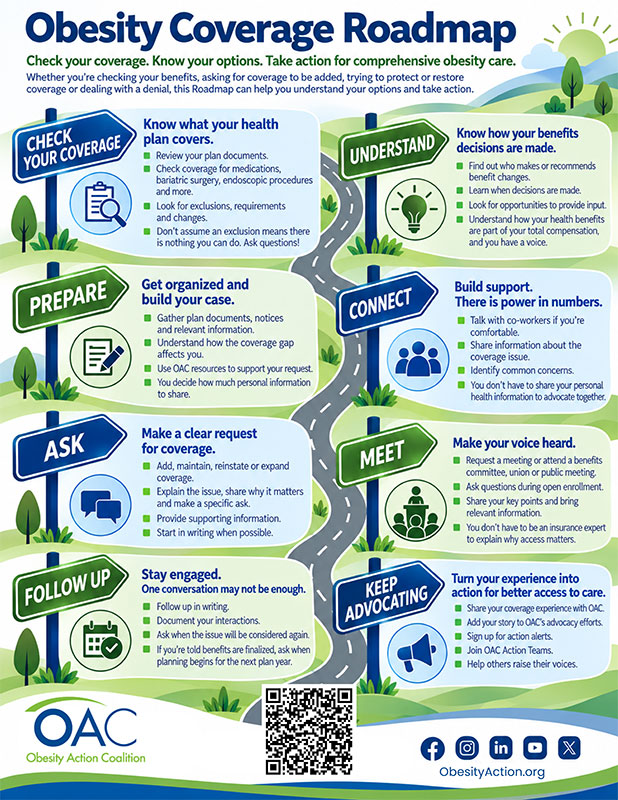
Check your coverage. Know your options. Take action for comprehensive obesity care. Whether you’re checking your benefits,…
View Guide
OAC’s white paper shares findings from a patient survey on prescription companion apps for obesity medications. Explore…
View Guide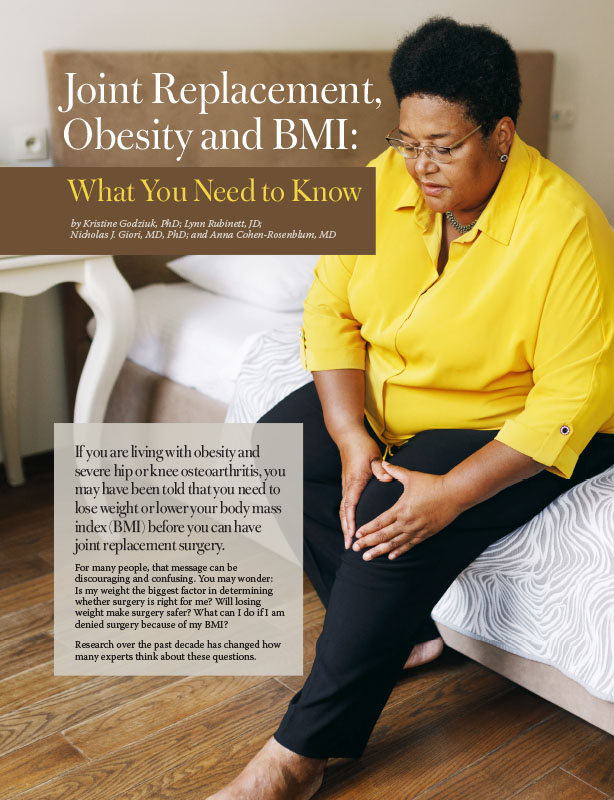
by Kristine Godziuk, PhD; Lynn Rubinett, JD; Nicholas J. Giori, MD, PhD; and Anna Cohen-Rosenblum, MD Fall…
Read Article