 Login



OAC Community Perspectives: Finding Care, Finding Her Voice

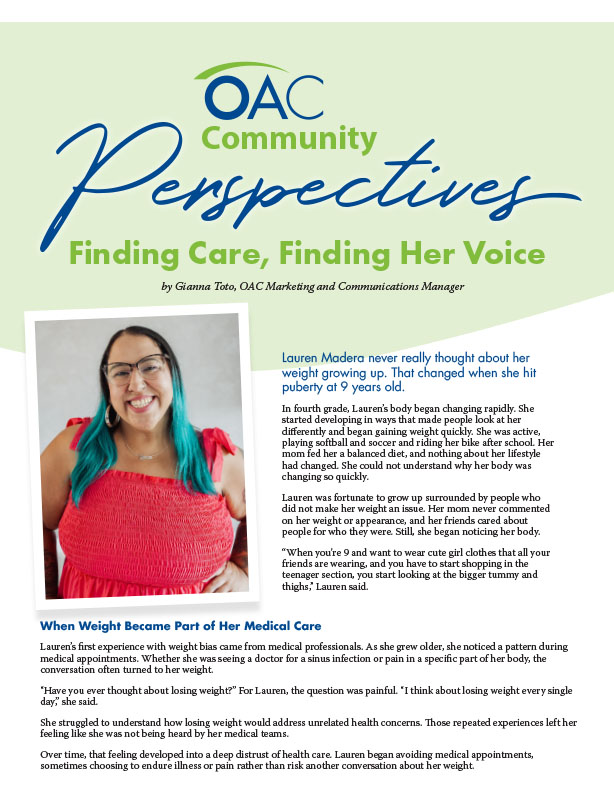
by Gianna Toto, OAC Marketing and Communications Manager
Fall 2026
Lauren Madera never really thought about her weight growing up. That changed when she hit puberty at 9 years old.
In fourth grade, Lauren’s body began changing rapidly. She started developing in ways that made people look at her differently and began gaining weight quickly. She was active, playing softball and soccer and riding her bike after school. Her mom fed her a balanced diet, and nothing about her lifestyle had changed. She could not understand why her body was changing so quickly.
Lauren was fortunate to grow up surrounded by people who did not make her weight an issue. Her mom never commented on her weight or appearance, and her friends cared about people for who they were. Still, she began noticing her body.
“When you’re 9 and want to wear cute girl clothes that all your friends are wearing, and you have to start shopping in the teenager section, you start looking at the bigger tummy and thighs,” Lauren said.
When Weight Became Part of Her Medical Care
Lauren’s first experience with weight bias came from medical professionals. As she grew older, she noticed a pattern during medical appointments. Whether she was seeing a doctor for a sinus infection or pain in a specific part of her body, the conversation often turned to her weight.
“Have you ever thought about losing weight?” For Lauren, the question was painful. “I think about losing weight every single day,” she said.
She struggled to understand how losing weight would address unrelated health concerns. Those repeated experiences left her feeling like she was not being heard by her medical teams.
Over time, that feeling developed into a deep distrust of health care. Lauren began avoiding medical appointments, sometimes choosing to endure illness or pain rather than risk another conversation about her weight.
Finding the Right Support
Lauren’s path toward rebuilding trust in health care began with therapy. She recognized that she needed support processing what she had been through before she could advocate for her physical health.
In 2022, a close friend referred Lauren to her current therapist, who helped her work through the medical distrust she had developed over the years. Then, in 2024, Lauren began seeing a new primary care provider recommended by another friend. Having a therapist she trusted and a primary care provider who listened gave Lauren a new sense of confidence in her health journey.
“Once I knew I had a therapist to support me mentally and a wonderful new PCP who would support me medically, I knew I was on the right path,” she said.
A New Understanding of Bariatric Surgery
Lauren’s perspective on bariatric surgery also changed as she learned more about obesity and its treatment. At first, she viewed bariatric surgery as the “easy way out.” She believed she simply was not disciplined enough or was not eating and exercising correctly.
A close friend, Dr. Marissa Mendez, helped Lauren see obesity differently. Mendez, a bariatric surgeon at Dartmouth Hitchcock Medical Center at the time, talked with Lauren about obesity as a disease and the role metabolic factors can play in the body. “She was using words and phrases that no medical professional had said to me before,” Lauren said. Those conversations helped Lauren recognize that she needed medical intervention. Her perspective shifted from shame to understanding. “I didn’t feel shame anymore, and I didn’t feel like bariatric surgery was the easy way out. In fact, I knew it would be the key to changing my life,” she said.
Getting approved for surgery was another challenge. Lauren worked with her primary care provider and several specialists to secure insurance coverage. The process took more than a year and a half.
Along the way, Lauren was offered the opportunity to speak at the 2026 American Society for Metabolic and Bariatric Surgery (ASMBS) conference, where she shared her experience to help others understand the challenges of seeking care and the importance of feeling heard and supported.
Giving Her Story a Voice
Speaking at the ASMBS conference was especially meaningful for Lauren. She participated in the panel “The Weight of Waiting,” where she met three other women who had also advocated for better care and understanding. For Lauren, the opportunity to speak addressed something she had felt throughout her journey: loneliness. “I always felt very alone on this journey,” she said. “I have people who love and support me, but nobody lives in this body but myself.”
Her goal was simple: If one person heard her story and felt less alone, she would consider the experience worthwhile. She accomplished that goal while also making connections that would ultimately help her find her surgeon. “I am forever grateful for this story and journey and want everyone who helped me along the way to understand how grateful I will forever be to them,” Lauren said. “They are truly a part of me forever.”
A New Chapter After Surgery
About one month after surgery, Lauren said she was feeling incredibly well. The first few days of recovery were difficult, but she kept returning to a phrase that continues to guide her: “Each day is its own journey.” Lauren has followed the recommendations of her surgeon and team as closely as possible. She describes the experience as an opportunity to build a new relationship with her body and health. There are still difficult days when she feels uncertain or wonders whether she is doing everything correctly. When those moments happen, she reminds herself of how hard she worked to reach this point. “It feels like such a gift to get this new shot at this relationship with my body and my health,” she said.
What She Wants Her Younger Self to Know
Lauren has always thought about the person she wants her younger self to become. She describes it as “older Lauren wanting to be the coolest and best version for younger Lauren to look up to.”
Today, she would tell her younger self that she deserves to be strong, supported and heard.
“Life will be tough at times, and the universe will throw things at you that you may not ever feel like you can endure,” Lauren said. “However, you are your own number one. Nobody is more important than yourself and the life you fight for and deserve.”
Lauren also wants others to know how important it is to have people who listen and support you. She credits her mom and friends with loving her without judgment and never making her feel that her appearance determined her worth.
“They never made me feel like I needed to worry about my looks and always loved me for my heart,” Lauren said. She knows that not everyone living in a larger body has that same experience. Many people face judgment and misunderstanding and may struggle to find the support they need. Lauren hopes her story reminds others that they deserve compassion, understanding and appropriate health care.
Most of all, she hopes that someone reading her story who feels alone will realize they are not. There are people who will listen. There are people who will stand beside them. And everyone deserves care that sees them as a whole person.
About the Author:
Gianna Toto, OAC Marketing and Communications Manager, helps bring the organization’s mission to life through engaging content across social media, newsletters, member emails and other communications. With a background in nonprofit work, she is passionate about building connections, sharing meaningful stories and helping grow a strong community around OAC’s work. Gianna attended the State University of New York College of Agriculture and Technology at Cobleskill, where she majored in Communications in Technology and minored in Marketing.
Related Resources

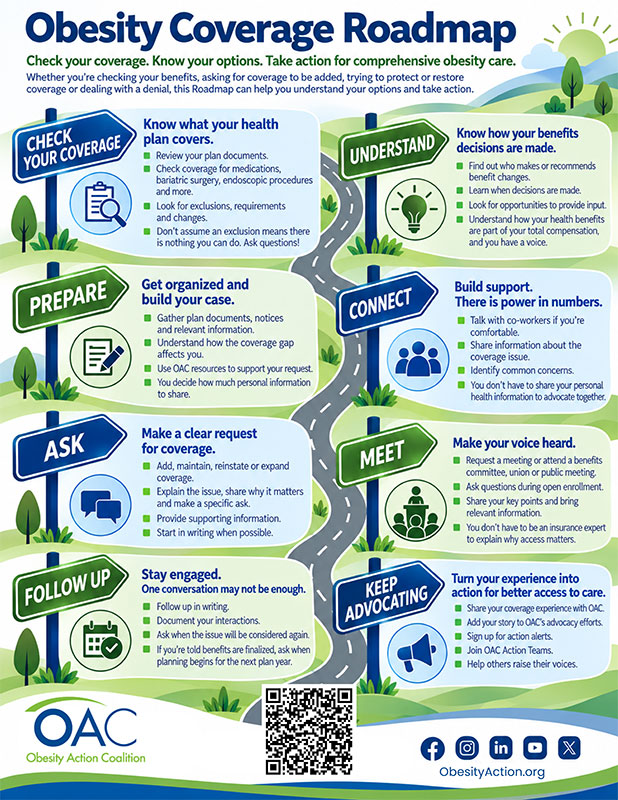
Check your coverage. Know your options. Take action for comprehensive obesity care. Whether you’re checking your benefits,…
View Guide
OAC’s white paper shares findings from a patient survey on prescription companion apps for obesity medications. Explore…
View Guide
by Kristine Godziuk, PhD; Lynn Rubinett, JD; Nicholas J. Giori, MD, PhD; and Anna Cohen-Rosenblum, MD Fall…
Read Article